

Research
The research activities of the Institute of Immunology focus on cytokine-producing cells of the immune system and their function in immune defense against viral, bacterial, and eukaryotic pathogens, as well as in the development of autoimmune diseases.
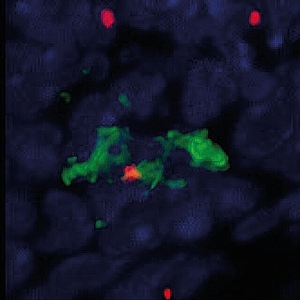
One focus of our work is on dendritic cells (DCs), the professional antigen-presenting cells, and on the cytokine family of type I interferons. Type I interferons play a key role at the interface between innate and adaptive immune responses in combating viral infections but also in the pathogenesis of neuroinflammatory diseases such as multiple sclerosis. Using sensitive fluorescence reporter mouse models, we visualize type I interferon producers in complex in vivo infection models at the cellular level and thus have direct access to characterize the cellular and molecular biological regulatory mechanisms of their differentiation and effector functions.
Here, we use bioinformatic methods in genome-wide multi-omics analyses and have recently been able to identify novel molecular regulators of type I interferon production specifically in plasmacytoid dendritic cells. This DC type in particular has the ability to produce high levels of type I interferon in response to a viral stimulus and thus can be crucial in the early control of viral infections. Furthermore, we are currently investigating the role of these plasmacytoid dendritic cells in the development of sepsis-induced immune dysregulation leading to increased susceptibility to secondary infections after surviving acute sepsis.
Another research topic concerns the biology of tetraspanins, which are transmembrane proteins that control numerous processes in CNS development and immune defense, among others. Tetraspanin 2 (Tspan2) was originally described in oligodendrocyte progenitor cells, but has remained poorly characterized to date. We are working to elucidate the role of Tspan2 in viral, bacterial, and fungal immune defenses and in CNS autoimmunity with direct relevance to the potential use of Tspan2 and other tetraspanins as therapeutic targets in anti-infective immune responses.
Our newly defined molecular regulatory mechanisms and properties of effector cells of the immune system provide an important basis for the new and further development of innovative vaccination and therapy strategies for infectious, but also autoimmune and tumor diseases.
Other Areas of Research: