

Molecular Cell Biology
Current Research Focus
DNA-binding transcription factors are crucial switches for modulating a wide variety of gene expression programs in a manner adapted to a cell’s needs in both time and space. The largest class of human transcription factors, comprising approximately 750 members, is formed by C2H2 zinc finger proteins (ZNF proteins). About half of them contain an N-terminal protein-protein interaction domain known as Krüppel-associated box (KRAB).
The canonical model for transcription regulation by KRAB-ZNF proteins posits that these transcription factors bind specifically to DNA via their zinc fingers and recruit multiprotein complexes via their KRAB domain. Ultimately, this DNA-bound complex converts the recognized gene locus into a state that is non-permissive for transcription (repression). A key cofactor in this model is the multidomain protein TRIM28 (synonym KAP1), which acts as a central hub to mediate interactions with proteins that modulate chromatin. Key interaction partners include heterochromatin proteins (HP1), the histone H3 lysine 9 methyltransferase SETDB1, and the “nucleosome remodeling and deacetylase” (NuRD) complex with its histone deacetylase activity.
The KRAB-ZNF/TRIM28 system plays a significant role in physiology and disease including stem cell biology, differentiation processes, the response to DNA damage, the suppression of retrotransposons and cancer.
The exact mechanisms by which a KRAB-ZNF/TRIM28 module regulates biological processes are far from fully elucidated. Open questions concern the regulation of the module, particularly which complexes influence gene regulation—when, how, under what biological conditions (cell type, cell cycle, endogenous and exogenous stimuli), in what manner, and at what level. The functions of the majority of KRAB-ZNF proteins remain equally unclear, particularly with regard to the identification of the target genes they regulate. The TRIM28/KRAB-ZNF system likely emerged during the evolution of tetrapods.
Elucidating the mechanisms of the TRIM28/KRAB-ZNF system and characterizing chemical compounds that influence this system are of great relevance for understanding and modulating programmable transrepressors such as dCas9-KRAB (CRISPRi methodology) in genetic engineering and gene therapy. In these fields, the KRAB domain of the KRAB-ZNF protein Kox1/ZNF10 is used to specifically silence genes.
Contact person
Dr. rer. nat. Peter Lorenz
0381 494 - 5879
peter.lorenz{bei}med.uni-rostock.de
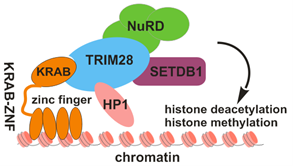
Figure: A model for transcriptional regulation by a KRAB zinc finger protein in conjunction with TRIM28 complexes at a chromatin locus.
Methodological Approaches
- Application of bioinformatics tools for phylogenetic analyses and gene expression analyses
- Use of knockout cell lines to investigate the function of components of gene regulatory processes
- Construction of custom eukaryotic expression vectors for transient and stable transfection of desired cell line models
- Elucidation of mechanisms of transcriptional control using reporter gene assays
- Study of protein complexes using co-immunoprecipitation or affinity chromatography followed by mass spectrometry (in collaboration with the Rostock Proteome Center)
- Analysis of gene expression profiles using quantitative real-time PCR
Literature
Czerwińska P, Mazurek S, Wiznerowicz M. The complexity of TRIM28 contribution to cancer. J Biomed Sci. 2017 Aug 29;24(1):63. doi: 10.1186/s12929-017-0374-4. Review. PMID: 28851455
Ecco G, Imbeault M, Trono D. KRAB zinc finger proteins. Development. 2017 Aug 1;144(15):2719-2729. doi: 10.1242/dev.132605. Review. PMID: 28765213
Cheng CT, Kuo CY, Ann DK. KAPtain in charge of multiple missions: Emerging roles of KAP1. World J Biol Chem. 2014 Aug 26;5(3):308-20. doi:10.4331/wjbc.v5.i3.308. Review. PMID: 25225599
Lupo A, Cesaro E, Montano G, Zurlo D, Izzo P, Costanzo P. KRAB-Zinc Finger Proteins: A Repressor Family Displaying Multiple Biological Functions. Curr Genomics. 2013 Jun;14(4):268-78. doi: 10.2174/13892029113149990002. PMID: 24294107
Iyengar S, Farnham PJ. KAP1 protein: an enigmatic master regulator of the genome. J Biol Chem. 2011 Jul 29;286(30):26267-76. doi: 10.1074/jbc.R111.252569. Review. PMID: 21652716
Lorenz P, Steinbeck F, Krause L, Thiesen HJ. Int J Mol Sci. 2022 Jan 19;23(3):1072. The KRAB Domain of ZNF10 Guides the Identification of Specific Amino Acids That Transform the Ancestral KRAB-A-Related Domain Present in Human PRDM9 into a Canonical Modern KRAB-A Domain. doi: 10.3390/ijms23031072. PMID: 35162997
Al Chiblak M, Steinbeck F, Thiesen HJ, Lorenz P. DUF3669, a "domain of unknown function" within ZNF746 and ZNF777, oligomerizes and contributes to transcriptional repression. BMC Mol Cell Biol. 2019 Dec 19;20(1):60. doi: 10.1186/s12860-019-0243-y. PMID: 31856708
Born N, Thiesen HJ, Lorenz P. The B-subdomain of the Xenopus laevis XFIN KRAB-AB domain is responsible for its weaker transcriptional repressor activity compared to human ZNF10/Kox1. PLoS One. 2014 Feb 3;9(2):e87609. doi:10.1371/journal.pone.0087609. eCollection 2014. PMID: 24498343
Lorenz P, Dietmann S, Wilhelm T, Koczan D, Autran S, Gad S, Wen G, Ding G, Li Y, Rousseau-Merck MF, Thiesen HJ. The ancient mammalian KRAB zinc finger gene cluster on human chromosome 8q24.3 illustrates principles of C2H2 zinc finger evolution associated with unique expression profiles in human tissues. BMC Genomics. 2010 Mar 26;11:206. doi: 10.1186/1471-2164-11-206. PMID: 20346131 Free PMC article.
Ding G, Lorenz P, Kreutzer M, Li Y, Thiesen HJ. SysZNF: the C2H2 zinc finger gene database. Nucleic Acids Res. 2009 Jan;37(Database issue):D267-73. doi: 10.1093/nar/gkn782. PMID: 18974185 Free PMC article.
Lorenz P, Koczan D, Thiesen HJ. Transcriptional repression mediated by the KRAB domain of the human C2H2 zinc finger protein Kox1/ZNF10 does not require histone deacetylation. Biol Chem. 2001 Apr;382(4):637-44. doi: 10.1515/BC.2001.075. PMID: 11405226